


Don't Trade F&O Without This: The F&O Margin Calculator Guide
FUTURE & OPTIONS
15th Oct 2026
By Rudra Shares
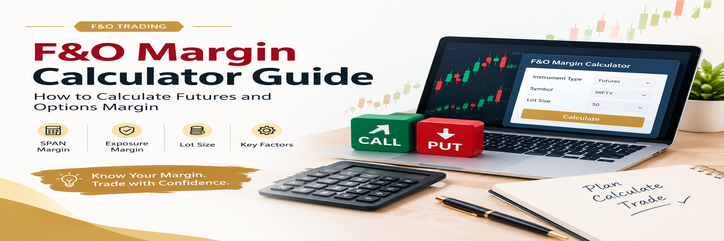
Futures and Options (F&O) trading is both exciting and risky, and it requires a significant capital investment. Among the key aspects that traders regularly disregard is margin - the smallest amount of money needed in your trading account to place a trade. It is here that an F&O Margin Calculator proves to be your best bet.
In this blog, we will discuss the F&O margin calculator, its operation, the reasons for having one, and how to use it profitably, without relying on technical terms.
What is F&O Trading?
Before getting into the margin calculator, let us first know what F&O trading is:
- Futures: Futures are contracts that allow one to buy or sell an asset at a given price in the future.
- Options: Options give the right to buy or sell an asset at a specified price on or before a given expiry date.
Both of them fall under derivative trading, which is typically used to hedge risk, speculate, or leverage their positions in the market.
What is Margin in F&O Trading?
You don’t need to pay the full value of the contract in F&O trading. Instead, a margin rate is used equal to the deposit amount. This margin relates to the type of exchange where the trader is active (example: The NSE, The BSE in India) and evolves according to such parameters as volatility, the amount of contracts and how the position was constructed (buying or selling).
Margin is of two kinds:
- Margin: Calculated based on the risk of your position.
- Exposure Margin: This is an additional margin to account for market volatility.
Both are required and must be in your trading account.
What is an F&O Margin Calculator?
An F&O margin calculator is an online tool that helps traders find out exactly how much margin they need before placing an order in the futures or options market.
It states you:
- Total margin required (SPAN + Exposure)
- Premium margin (for option buyers)
- Intraday vs. positional margin
- Margin benefits from hedging strategies
This tool is usually available on most broker websites.
How Does It Work?
Computing an F&O margin with an F&O calculator follows the steps listed below:
Step 1: Select Your Trade
- Choose whether you want to trade in futures or options.
- Select the index or stock (such as NIFTY, BANKNIFTY, RELIANCE, etc.).
Step 2: Enter Details of the Trade
- Quantity (Number of lots)
- Position type: Buy or Sell
- Option: select strike and expiry
Step 3: Look at Margin Breakdown
The calculator will show
- SPAN margin
- Exposure margin
- Total required margin
- Premium (when buying options)
It will also tell you how many margin points you will save in case you implement hedging strategies such as buying an option and selling another.
Why You Should Use an F&O Margin Calculator
A margin calculator is not only helpful, but crucial as well. Here’s why:
- Avoid Margin Shortfalls: When you enter into a trade and you find that you have insufficient funds in your account, it is referred to as a margin shortfall. A margin calculator will remind you beforehand how much you require, and help prevent order rejection or penalties.
- Improved risk management: Understanding your margin requirement can allow you to plan your position and related risk exposure. This averts the over-leveraging.
- Plan Strategies Efficiently: Multi-leg strategies, such as spreads and straddles, break down margining by strategy type, allowing you to plan effectively.
- Adhere to the SEBI Regulations: SEBI (The market regulator in India) has tightened the margin regulations. With a calculator, you will have to make sure you obey these rules, and you will avoid the penalties/ auto-square-offs.
Real-Life Example
Suppose you want to sell one lot of NIFTY Futures.
- Each lot = 50 units
The share price of NIFTY is 22,000
- Margin calculator shows
SPAN = 90,000
Exposure: 30,000
Total =Rs.1,20,000
This means you will need a minimum of ₹120000 to do this trade. In case you attempt trading without making the check and you only possess 1 lakh, your order will be lost.
Suppose now you also purchase a protective call option--your margin can drop considerably under the hedging effect. The calculator will indicate the adjusted amount
Conclusion
Never trade F&O without applying a margin calculator. It is the tool that allows you to safeguard your capital, observe compliance, and make wiser decisions. No matter whether you are a beginner or an experienced trader, the issue of margin clarity is vital to successful trading.
With the help of an F&O margin calculator, you become the master of your trades and minimize the risk of unforeseen margin calls or losses.
Choose the firm that offers lowest brokerage charges and Calculate the margin before you make your next trade.
Download Our App
Rudra MINT+
Available On







Attention Investor
Dos and Don’ts for Retail Investors:
- 1) Offering fixed/guaranteed/regular returns/ capital protection schemes in stock markets whether written or oral is not allowed. Any of our representative or Authorised Person (AP) cannot offer fixed/guaranteed returns.
- 2) Any representative cannot enter into loan agreements to pay interest on funds/securities.
- 3) Do not fall prey to emails, SMSs, or videos promising high returns.
- 4) Trading in derivatives involves high risk.
- 5) Dealing in cash is prohibited.
- 6) Do not share login ID, password, OTP, TPIN.
- 7) Fill KYC details yourself and keep copies.
- 8) Ensure trades are executed as per your instructions.
- 9) Keep mobile/email updated and verify trade messages.
- 10) Verify bank details before transferring funds.
- 11) Prevent Unauthorized Transactions in your demat account --> Update your Mobile Number with your Depository Participant. Receive alerts on your Registered Mobile for all debit and other important transactions in your demat account directly from CDSL on the same day issued in the interest of investors.
- 12) KYC is a one-time exercise while dealing in securities markets - once KYC is done through a SEBIregistered intermediary (broker, DP, Mutual Fund etc.), you need not undergo the same process again when you approach another intermediary.
- 13) No need to issue cheques by investors while subscribing to an IPO. Just write the bank account number and sign in the application form to authorize your bank to make payment in case of allotment. No worries for a refund, as the money remains in the investor's account.